Pages

Wednesday, March 5, 2014

WPP #12: Unit O Concept 10: Angles of Elevation and Depression

http://gomighty.com/wp-content/themes/gomighty/lib/goal_images/files/Hot-Air-Balloon.jpg

The Problem
a) Andrew is at ground level and measures the angle of elevation to the hot air balloon to be 37*. If, at this point he is 57 feet away from the hot air balloon, what is the height of the hot air balloon from the ground? (round to the nearest foot)

b) Andrew is now in the hot air balloon and measures the angle of depression which is 25*. Andrew knows that he is 240 feet high up in the air than the base of the forest. How far away horizontally is Andrew from the forest? (round to the nearest foot)

The Solutions


Tuesday, March 4, 2014

I/D #2: Unit O: Derive the Special Right Triangles

Inquiry Activity Summary

Derive the 45-45-90 triangle from an square with a side length of 1


Derive the 30-60-90 triangle from an equilateral triangle with a side length of 1


Inquiry Activity Reflection

Something I never noticed before about the special right triangles is where the triangle comes from. I did not know that the 45-45-90 degree triangle came from a square and that the 30-60-90 degree triangle came from half an equilateral triangle. It was interesting to find out that so much can be found with the Pythagorean Theorem.
Being able to derive these patterns myself aids in my learning because if I forget the rules for the special right triangles I will be able to derive them from a square and the equilateral triangle with the side lengths of 1. I also will know how to use the Pythagorean theorem to determine the side and substitute the values for the variable n, so any other multiples of those values can be used. 


Saturday, February 22, 2014

I/D #1: Unit N Concept 7- Unit Circle Derivation

Inquiry Activity Summary

1. 30* Right Triangle


2. 45* Right Triangle


3. 60* Right Triangle


4. This activity showed me where the values from the unit circle came from which was the special right triangles. Getting the three triangles let me know that they are the same in each quadrant so it leads to knowing the entire unit circle

Different angles in different quadrants
5. The triangles in the videos are all in the first quadrant and the ordered pairs are positive. Redrawing the 30* angle in the second quadrant made the x values become negative. The 45* angle in the third quadrant makes both x and y values become negative.The 60* angle in the fourth quadrant makes the y values become negative.


Inquiry Activity Reflection

1. The coolest thing I learned from this activity was learning where the numbers for the unit circle come from. I now know if I'm given some sort of right angle that I can solve for the points.

2. This activity will help me in this unit because this is the first time that I have been introduced to the unit circle and it is a great way to remember the values of the points of the graph.

3. Something I never realized before about special right triangles and the unit circle is the points are directly correlated and that a triangle will let me know the points on the graph.


Monday, February 10, 2014

RWA1: Unit M Concepts 4-6: Conic Sections in Real Life

1. Defintion:
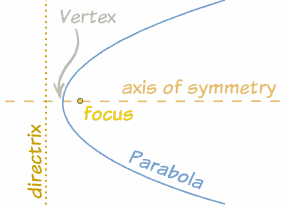
 A parabola is the set of all points the same distance from a point, known as the focus, and a line, known as the directrix.
parabola
(http://www.mathsisfun.com/geometry/parabola.html)
2. Description:
The algebraic equation or formula for a parabola is
(x-h)²=4p(y-k) or (y-k)²=4p(x-h). A parabola is a curve and it is arch-like or in other words "U-shaped" which is symmetrical to the other side of the graph. The parabola has a vertex which the bottom point of a parabola and it is shown as the (h,k) in the equation and it is the point where the axis of symmetry divides the parabola. The axis of symmetry splits the parabola where both sides are a mirror image of each other and this axis of symmetry can be vertical or horizontal, the axis of symmetry depends on the direction of the parabola going up/down (x=#) or parabola going left/right (y=#). In order to decide if it goes up/down or left/right you look at the squared term and if the x value is squared then the parabola goes either up/down and if the y value is squared then the parabola goes right/left. To get the direction of the parabola you have to find the p value and if it is negative it goes down/left and if the p value is positive it goes up/right.


Also, the focus is p value units away from the vertex and also lies on the axis of symmetry and the focus will always be "inside" the parabola. The closer the focus is to the the vertex the skinnier the graph and the further away the focus is from the vertex, the fatter the graph. The directrix is the opposite direction form the focus and is p units away from the vertex in the opposite direction and the value would be perpendicular to the axis of symmetry. So, if the axis of symmetry is y=# then the directrix would be x=#.


3. Real World Application:
Flashlights is where parabolas go into action and it helps to focus light into a certain beam. The shape of the flashlights reflectors is a parabola and the light bulb is at the focus of the parabola. The rays given off from the focus point and the light is reflected parallel in straight lines to the axis of symmetry. "Since light is a wave, if a light source is  placed at the focus of a paraboloid the result will be a focused beam of light emerging outward along the direction of the axis."(http://jwilson.coe.uga.edu/EMAT6680Fa08/Wisdom/EMAT6690/Parabolanjw/reflectiveproperty.htm)
(http://jwilson.coe.uga.edu/EMAT6680Fa08/Wisdom/EMAT6690/Parabolanjw/reflectiveproperty.htm)
Therefore the shape of the flashlight reflectors allow light to go in the direction of the axis and the more the light is aimed in different places, the more different the lighting is. Also the lighting would be different due to where the filament is located and it can bend the light waves and change where the light goes. So if we "offset the filament from the focus and change the beam entirely" would aim the light in different directions. (http://www.pleacher.com/mp/mlessons/calculus/appparab.html)

(http://www.pleacher.com/mp/mlessons/calculus/appparab.html)


4. Works Cited: 
  • http://www.mathsisfun.com/geometry/parabola.html
  • http://jwilson.coe.uga.edu/EMAT6680Fa08/Wisdom/EMAT6690/Parabolanjw/reflectiveproperty.htm
  • http://www.youtube.com
  • http://www.pleacher.com/mp/mlessons/calculus/appparab.html

Sunday, December 8, 2013

Unit K Concept 10: SP#6

You need to pay special attention when converting the a sub 1 or first number into a fraction and also the common difference or r. The common difference is found by dividing the second term and the first term. Then plug in the numbers into the equation and in the end remember to add the whole number.